
Rising electricity tariffs are squeezing Indonesian manufacturers. Discover how BROAD Indonesia’s gas-fired absorption chillers eliminate up to 50% of cooling energy costs — without sacrificing performance.
The problem: electricity costs are eating industrial profits
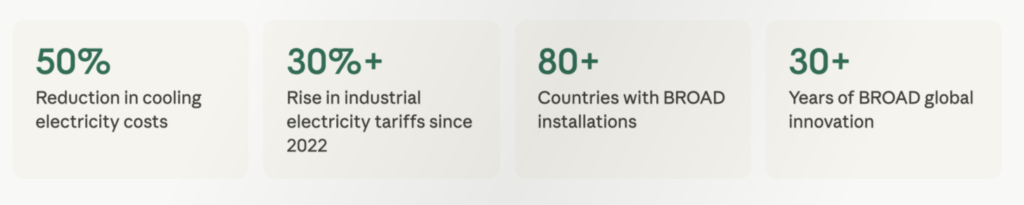
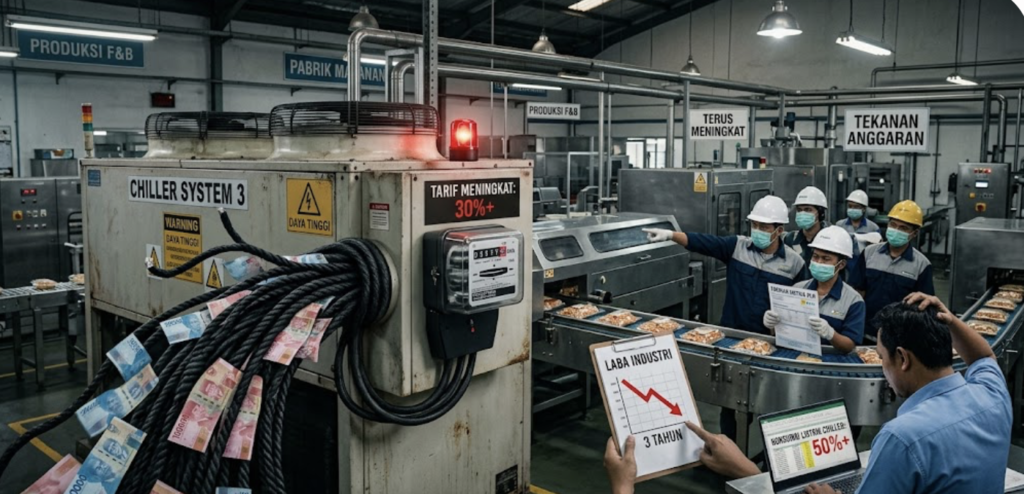
Indonesia’s industrial electricity tariff has climbed more than 30% over the past three years, and analysts project further increases as the country transitions its energy mix. For factories in food & beverage, pharmaceuticals, textiles, and chemicals, cooling is not optional — it is a core production requirement. Yet the conventional approach to industrial cooling, large electric chillers running on grid power, was designed in an era of cheap electricity.
For a medium-scale manufacturing plant, chillers and their associated pumping systems typically account for 40–60% of total electricity consumption. As tariffs rise, this line item grows disproportionately. Plant managers are caught between productivity demands and budget constraints, with limited options under the conventional model
“In today’s competitive industrial landscape, energy efficiency is no longer an option — it is a necessity. Rising fuel prices, climate change regulations, and the growing demand for sustainable operations push companies to adopt smarter solutions.”
What is an absorption chiller — and why does it change everything?
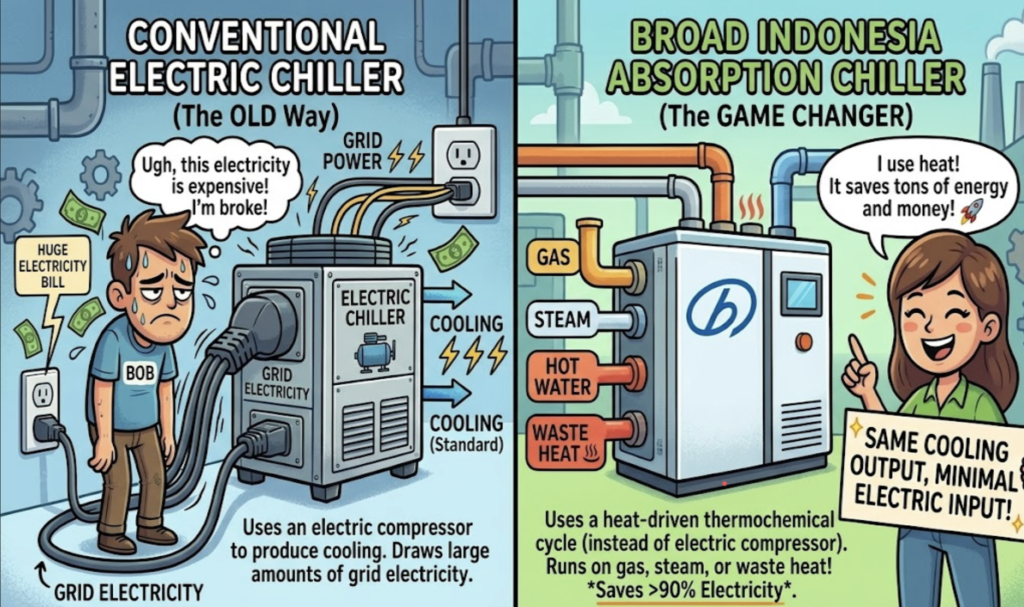
A conventional electric chiller uses an electrically driven compressor to produce cooling. An absorption chiller replaces the electric compressor with a heat-driven thermochemical cycle. Instead of drawing large amounts of grid electricity, the absorption chiller uses gas, steam, hot water, or waste heat as its primary energy source.
BROAD Indonesia’s gas-fired absorption chillers are engineered to deliver the same cooling output as electric systems — but at a fraction of the electrical energy input. When paired with a gas engine or industrial process that generates waste heat, the economics become even more compelling: the “fuel” for cooling is energy that would otherwise be discarded.
How BROAD absorption chillers deliver 50% cost savings
- Gas replaces grid electricity as the primary energy input — directly reducing dependence on PLN tariffs
- Waste heat from gas engines or industrial processes is captured and converted into free cooling via BROAD’s absorption cycle
- BROAD’s packaged pump distribution system saves an additional 75% of auxiliary pumping energy — a hidden cost most facilities never address
- No oil lubrication required — lower maintenance costs and zero contamination risk for sensitive production environments
- Smart variable-flow controls optimize energy use across partial-load conditions, which represent most real-world operating hours
- Carbon emissions are significantly reduced, supporting ESG reporting and Indonesia’s NDC climate commitments
Proven results: SUPARMA PT Tbk
Case Study · Paper & Packaging Industry
SUPARMA PT Tbk — sustainable absorption chiller deployment
BROAD Indonesia partnered with SUPARMA PT Tbk to deliver a customized absorption chiller solution that addressed the facility’s specific cooling requirements while dramatically reducing energy expenditure. The project demonstrated that BROAD’s technology is not limited to food processing — it delivers equally strong results across paper, packaging, and industrial manufacturing environments. The collaboration reinforced BROAD Indonesia’s ability to execute technically complex installations with measurable, long-term value.
Frequently asked questions
Is absorption chiller technology suitable for existing facilities, or only new builds?
BROAD Indonesia provides complete energy renovation services for existing facilities. The team conducts an energy diagnosis first, then designs a retrofit solution that integrates with existing infrastructure. The Aalst Chocolate case study in Singapore demonstrates a full renovation of an operating food production facility with minimal disruption to production continuity.
What is the typical payback period for switching to BROAD absorption chillers?
Payback periods vary by facility size, current energy costs, and gas availability, but many Indonesian industrial clients see positive ROI within 3–5 years. As electricity tariffs continue to rise, this timeline improves further with each tariff increase.
Does BROAD Indonesia provide after-sales service and maintenance support?
Yes. BROAD Indonesia offers full technical consultation, installation, commissioning, and ongoing operation management services. BROAD’s parent company has been operating globally for over 30 years with installations in more than 80 countries.
Is natural gas required, or can the system use other heat sources?
BROAD absorption chillers can be driven by natural gas, steam, industrial waste heat, exhaust gas from engines, or hot water recovered from industrial processes. This flexibility means the technology can be adapted to the specific energy profile of each facility.