
Rising Electricity Bills? Your Chiller Could Be the Reason.
For many industrial facilities, electricity has become one of the largest operational expenses. Yet many factories experience increasing energy costs even though production levels and cooling demand remain relatively unchanged.
One of the most common causes is an aging or inefficient chiller system.
Industrial chillers operate continuously to provide cooling for manufacturing processes, commercial buildings, hospitals, and data centers. As equipment ages, its efficiency gradually declines, forcing compressors, pumps, and auxiliary equipment to consume more electricity to deliver the same cooling capacity.
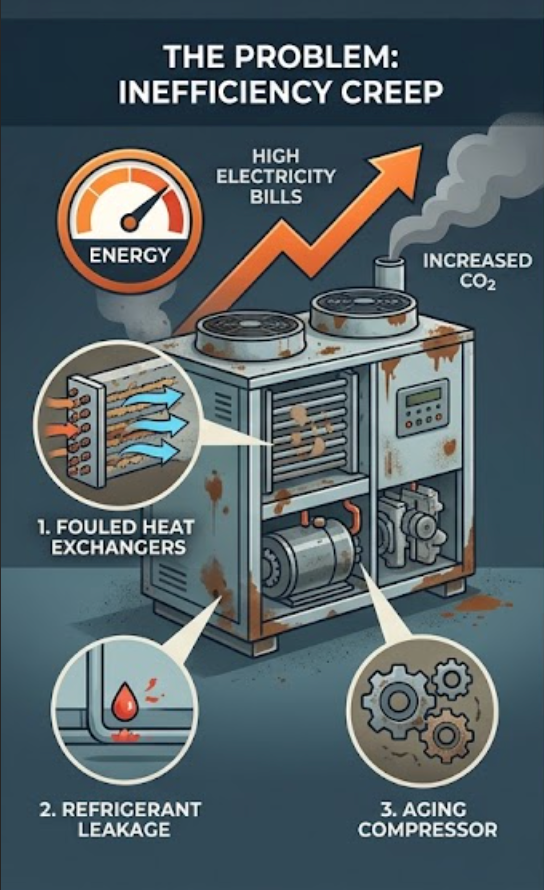
Why Does Chiller Efficiency Decrease?
Several factors contribute to declining performance:
1. Heat Exchanger Fouling
Dust, scale, and dirt reduce heat transfer efficiency, forcing the compressor to work harder.
2. Refrigerant Leakage
Even a small refrigerant loss can significantly reduce cooling performance while increasing energy consumption.
3. Aging Compressors
Mechanical wear lowers compressor efficiency, increasing power consumption and maintenance costs.
4. Poor System Controls
Older chillers often lack intelligent control systems that optimize cooling based on actual building or process demand.
5. Improper Maintenance
Delayed preventive maintenance can lead to clogged filters, reduced water flow, and unnecessary energy losses.
The Hidden Cost of Inefficient Cooling
An inefficient HVAC system affects more than just electricity bills.
It can lead to:
- Higher operating costs
- Increased carbon emissions
- Unexpected equipment downtime
- Reduced production reliability
- Shorter equipment lifespan
Many facilities unknowingly spend thousands of dollars each year on excess energy consumption that could be avoided.
How High-Efficiency Chillers Reduce Energy Consumption
Modern chiller technologies are designed to maximize cooling performance while minimizing electricity usage.
High-efficiency systems typically include:
- Advanced compressor technology
- Intelligent control systems
- High-performance heat exchangers
- Optimized part-load operation
- Low lifecycle maintenance requirements
When properly selected and operated, these systems can significantly reduce annual operating costs while supporting corporate sustainability goals.
Why Energy Efficiency Matters for ESG
Today, many companies are working toward Environmental, Social, and Governance (ESG) objectives.
Improving HVAC efficiency contributes by:
- Reducing electricity consumption
- Lowering greenhouse gas emissions
- Supporting carbon reduction initiatives
- Improving operational sustainability
Energy-efficient cooling is no longer simply a cost-saving investment—it has become part of a company’s long-term sustainability strategy.
Why Choose BROAD Indonesia?
BROAD Indonesia delivers innovative HVAC solutions designed for industries seeking higher efficiency, lower operating costs, and reliable long-term performance.
Our solutions are engineered to:
- Improve cooling efficiency
- Reduce electricity consumption
- Lower total lifecycle costs
- Support sustainable industrial development
Whether your facility is planning a new installation or upgrading an existing system, selecting the right chiller technology can create measurable savings for years to come.
Contact BROAD Indonesia
Want to know how much energy your facility could save?
Contact BROAD Indonesia today for a professional consultation and discover the most efficient cooling solution for your business.